
The site on Monte Torretta di Pietragalla
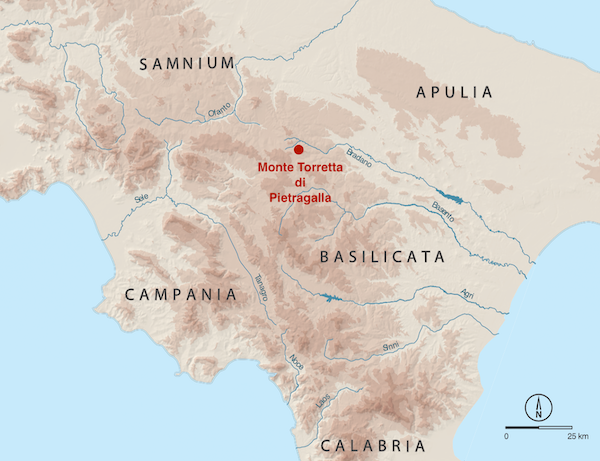
Monte Torretta is located in the mountainous inland of southern Italy, a region historically known as ancient Lucania. The archaeological site lays atop of an elongated hill located at 1070 m above sea level and near the spring of the Bradano river, not far away from a crossroad named ad fluvium Bradanum in the late 3rd-century AD Antonine Itinerary on the road between ancient Venusium (act. Venosa) and Potentia (act. Potenza). It belongs to the territory of the modern municipality of Pietragalla on the outskirts of Potenza in the Basilicata region.
The hill and adjacent land were once the property of the Duke of Casalaspro. In the early 1950s Vincenzo Possidente, who wanted to launch a farming activity, bought the land of Monte Torretta from the noble family. During the preparatory work for the land, however, some artifacts emerged and local authorities came to investigate. Once arrived on Monte Torretta, the archaeologist Francesco Ranaldi, newly appointed director of the Museo Archeologico Provinciale di Potenza, realised the archaeological wealth of the site, testified not only by the artifacts found on the land, but also by the still visible remains of an impressive fortification wall. In 1956, he obtained the hilltop to be archaeologically constrained and launched the first official archaeological investigation of Monte Torretta di Pietragalla. The land however remained until today a private property.
Based on the archives and archaeological materials recovered from the Museo Archeologico Provinciale di Potenza and contextualised by our own archaeological activity on site, the following historical sequence can be established – pending, of course, the results of current research.
The earliest human presence at Monte Torretta dates back to the Final Neolithic. Additionally, a few sherds of coarse impasto pottery suggests that the site was frequented during the Late Bronze Age (ca. 12th c. BC). After a nearly four-century documentary hiatus, significant evidence reemerges with a magnificent bronze dragon-type fibula from the second half of the 8th c. BC.
Evidence for the pre-Classical period is exclusively derived from burial remains, featuring ornamental objects from the late 7th c. and a few 6th-c. vases in subgeometric style, such as this beautiful duck-shaped askos. The rediscovery of various architectural terracotta fragments also suggests the existence of one or more significant architectural structures on the hill during the second half of the 6th c. This evidence points to a scattered settlement structure, with clusters of buildings and related cemeteries located along the southern side of what would later become the fortification wall.
For the Classical period, a bronze statuette of Herakles from the mid-5th c. was rediscovered in a safe at the Museo Archeologico Provinciale di Potenza. Unfortunately, a second bronze statuette of Herakles, dating to the first half of the 4th c. and known from old photographs, is missing from the storerooms. These statuettes likely indicate the presence of a cult dedicated to Herakles on Monte Torretta.
Towards the late 4th or early 3rd c. BC, as almost everywhere in Lucania, a complex fortification was built on the hilltop. This included an "outer wall" encompassing a large part of the plateau, accessed through a monumental gate (“Porta Marie”, re-excavated and documented in 2019) and an "inner wall" defining the boundaries of an “acropolis”. The latter was reached via a sloping passageway (“Porta Livia”). Judging from the limited excavation photographs captured by Ranaldi, part of his work focused on exposing the two walls. During our own exploration of the area, we successfully relocated Ranaldi’s trenches and re-exposed the full circuit wall, yielding new stratigraphic data for dating and understanding the construction of this intricate system. We also discovered additional trenches within the enclosed area, likely excavated by Adamesteanu.
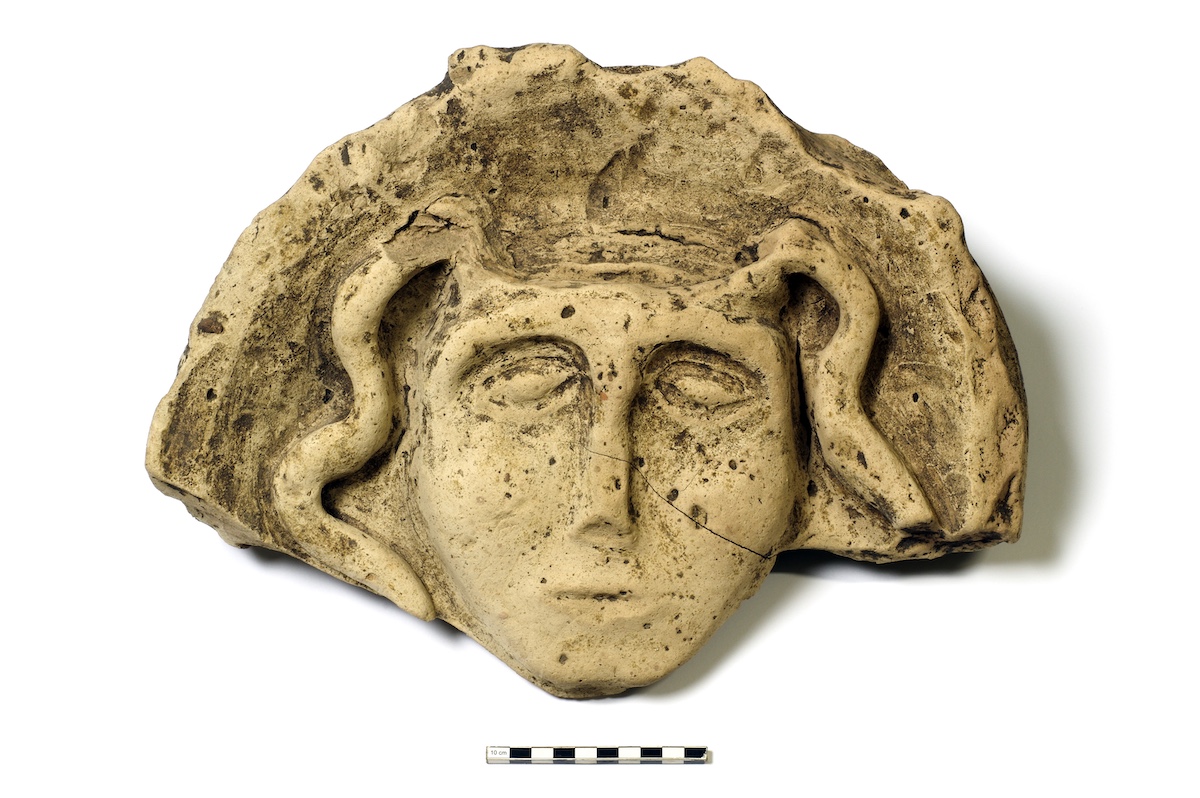
Gorgon acroterion from Monte Torretta di Pietragalla, Museo Archeologico Provinciale di Potenza.
To the same period, the late 4th or early 3rd c. BC, belongs a unique Gorgon acroterion, found – based on Adamesteanu’s testimony – in the central part of the fortified area. Such a piece of local craftsmanship but Greek inspiration probably belonged to the architectural decoration of a cult building, located within the walls as suggested by its findspot.
These findings highlight a fully developed ancient settlement with a multi-century history and a stable occupation until at least the end of the 3rd century BC, as the ongoing study of the pottery proves. This raises the crucial question of why the settlement was provided with a fortification wall in its heyday and then, a century later, was gradually abandoned, mirroring the fate of many other Lucanian hilltop sites. During the Roman expansion from the 4th c. BC onward, these settlements gained importance, likely due to privileges granted to Italic elites. However, with Rome’s full control of southern Italy, these isolated hilltop sites were abandoned in favor of new towns in valleys and along major roads, such as Potentia (Potenza). These sites record the gradual transformation and Roman strategies for incorporating new territories.
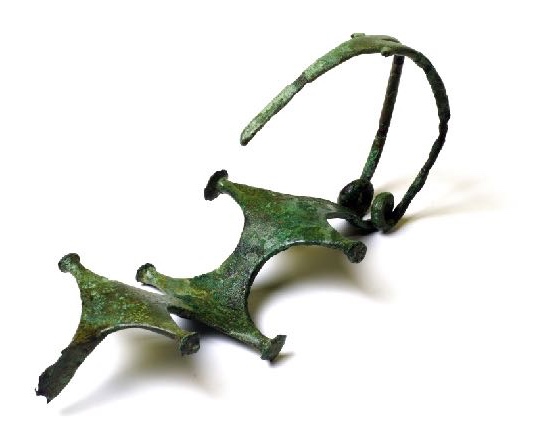
Bronze dragon-type fibula from Monte Torretta di Pietragalla, Museo Archeologico Provinciale di Potenza.
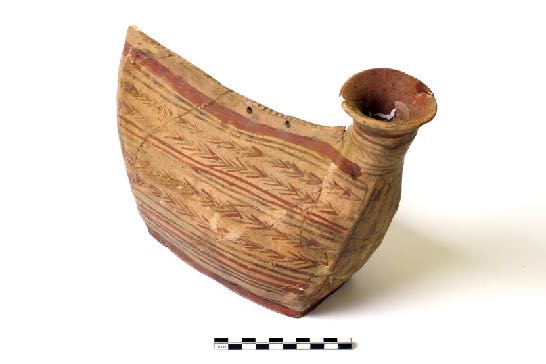
Subgeometric duck-shaped askos from Monte Torretta di Pietragalla, Museo Archeologico Provinciale di Potenza.
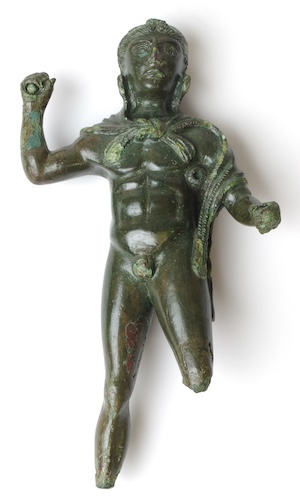
Bronze statuette of Herakles from Monte Torretta di Pietragalla, Museo Archeologico Provinciale di Potenza.