
Monte Torretta di Pietragalla
Monte Torretta di Pietragalla is located in the mountainous inland of southern Italy, historically known as Lucania, and offers a unique perspective for the study of the long-term evolution of settlement patterns and socio-political dynamics in the region. The extensive chronological evidence of the site (from the Late Bronze Age to the late 3rd century BC) provides a unique opportunity to study how Italic communities transformed their landscapes and adapted to the socio-cultural changes that eventually led to the integration of Lucania into the Roman world.
A landmark in the history of archaeology in ancient Lucania
Just two years after his appointment as director of the Museo archeologico provinciale di Potenza in 1954, Francesco Ranaldi launched one of the most important archaeological research projects of the time in Basilicata. The investigations on Monte Torretta, which turned out to be an important pre-Roman hilltop fortified site, brought to light a large part of the fortification system that can still be seen today. Ranaldi’s discoveries on Monte Torretta (1956–1965) were never published until his tragic suicide in the premises of the museum in 1988. In the meantime, the Soprintendenza archeologica della Basilicata had been created in 1964 and its energetic director, Dinu Adamesteanu, who became famous for organising modern archaeological researches in Basilicata and revealing its ancient peoples to the world, had engaged in a new series of archaeological campaigns on the site (1969–1992), which were never published either.
The materials and documents from Ranaldi’s excavations, which were thought to be lost for years, were rediscovered by a team from the Université Paris 1 Panthéon-Sorbonne in 2014 during the reorganisation of the museum’s storage rooms. At the same time, this study was connected to research on fortification architecture in Lucania carried out at Humboldt-Universität zu Berlin. The Pietragalla Project was born.
The Pietragalla Project: An archaeology for scholars and the public
The Pietragalla Project is an international research program established by the Université Paris 1 Panthéon-Sorbonne and the Humboldt-Universität zu Berlin, collaborating with a series of Italian partners. The main objective of the project is to study and promote the archaeological and cultural heritage of the archaeological site of Monte Torretta di Pietragalla.
One of the guiding principles of the Pietragalla Project is to promote a sustainable archaeology, that is – beyond the erudite aspect of our research – an archaeology for the public. The concept stems from an awareness that science cannot exist for its own sake but must also act as an instrument for the community. This principle is embodied in the close relationship between the academic partners and the local institutions involved in the Pietragalla Project. We believe that the only way to investigate the past is through a collaboration between local, national and foreign institutions.
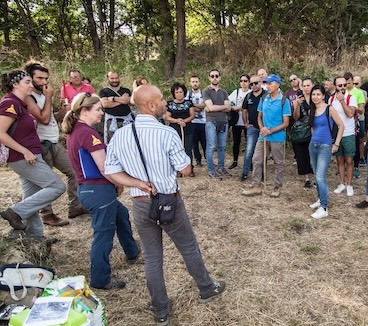
With local associations, we regularly organise visits on the site, concerts and conferences for the public throughout the year and especially for the European Archaeology Days.
The Pietragalla Project can be visualised as a three-stage rocket:
- The first phase, which lasted from 2014 to 2017, consisted of scouring the archives and storerooms of the Museo archeologico provinciale di Potenza in search of documentation and material from the old excavations. It led to the opening of a new exhibit section in the museum rooms about the rediscovery of the treasuries from Monte Torretta.
- The second phase, carried out on the field between 2017 and 2023, aimed to locate the physical evidence of these old trenches, and thus to re-contextualise the artefacts previously catalogued in the museum's storerooms. Another important goal was to survey the area of the settlement, rediscover the fortifications and document their construction techniques. Old and new data together provide a complex picture of the settlement's history.
- The third phase, which started in 2025, is focusing on collating and completing the documentation and synthesising the results of the two previous phases into a comprehensive monograph on the archaeology of Monte Torretta di Pietragalla, placing it within the broader history of pre-Roman hilltop settlements in ancient Lucania.
Since its inception, the Pietragalla Project has been granted the scientific label of the French-Italian University (UFI/UIF). In 2025, it was awarded a prestigious Shelby White and Leon Levy grant by Harvard University to complete the study and publication of previous excavations.